Heat Pump and Radiant Zoning: How to Design a Heating and Cooling System That Actually Works
Choosing between air-to-water and ground-source heat pumps, managing two-pipe vs four-pipe fan coils, and why two tanks are non-negotiable.
A hydronic heat pump system that handles both heating and cooling in a cold climate needs more than the right equipment, it needs a system approach. That means choosing a heat source sized to the heating load, selecting cooling emitters that are practical to control, using thermostats capable of two-stage heating with integrated cooling, and specifying two tanks. Skip any of those elements and you sacrifice the efficiency and comfort the system was supposed to deliver.
Choosing the Heat Pump: Air-to-Water vs. Ground Source
In climates that see -30 degrees C, the heating load dominates, and the system has to be sized for it. Cooling loads in those same climates are considerably smaller. That asymmetry matters when selecting a heat pump type.
Air-to-water heat pumps use ambient outdoor air to recover or reject heat through an external compressor unit that delivers hot or cold water via a heat exchanger. The system is simpler and less expensive to install. The tradeoff is efficiency drop-off at low outdoor temperatures, around 0 degrees C, there is not much recoverable heat in the air, and the system's coefficient of performance falls. A boiler backup takes care of the remaining load in extreme cold, which makes the higher cost of a ground-source system harder to justify.
Ground-source (water-to-water) systems are more consistent in cold weather because they draw from the ground, where temperatures are relatively stable. But the cost of drilling or trenching a ground loop is substantial. Given that a boiler backup is good practice regardless of heat pump type, the incremental efficiency gain from a ground-source system often does not offset the installation premium. An air-to-water heat pump with boiler backup is frequently the more practical choice.
Cooling Options: Fan Coils vs. Radiant
Radiant cooling in the floor is possible, but it carries a real condensation risk, particularly with expensive hardwood flooring. The dew point constraints mean the system has to maintain careful control of supply water temperature at all times, go a degree below dew point and condensation starts, and it does not clear the moment conditions improve. For a $50,000 floor, that risk deserves serious consideration.
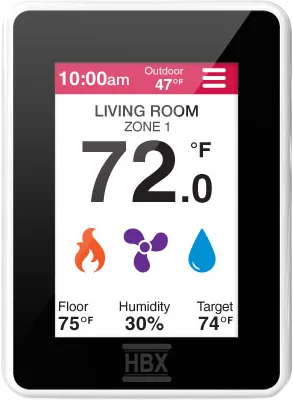
Fan coils simplify the cooling side considerably. They also serve as secondary heating, which means a thermostat can call first-stage heat to the radiant floor and second-stage heat to the fan coil, useful on the coldest days when the floor heat alone is not enough. The HBX THM-0600 thermostat handles exactly this configuration: two-stage heating, single-stage cooling, plus humidity control and intermittent fan control for additional flexibility.
Two-pipe fan coil systems run heating and cooling water through the same heat exchanger coil. Four-pipe systems keep them separate, with two pipes for heating water and two for cooling water. Four-pipe systems allow simultaneous heating and cooling in different zones, which is a significant advantage in buildings where solar gain creates cooling loads in one area while another area needs heat.
Zone Controls That Handle Both Heating and Cooling
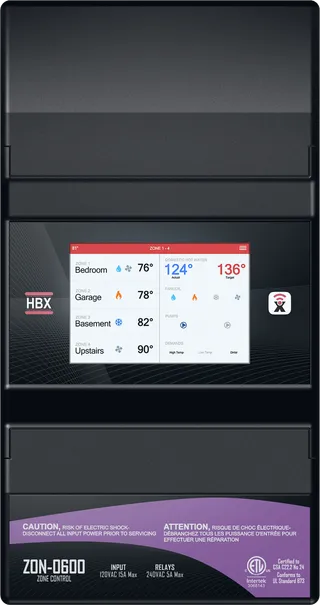
The zone control for a heat pump radiant system needs to manage both radiant heating zones and the air-side fan coil system simultaneously. Basic relay-box zone controls are not designed for this. Using a simple relay box and adding auxiliary switches to make it work creates a system that is difficult to troubleshoot and hard to hand off to the next technician. Using two separate thermostats to do one job creates the same problems.
A zone control built specifically for heat pump zoning, like the HBX ZON-0600, integrates the air-side damper control alongside the hydronic zone management. That means a single controller can direct radiant heating to each zone as the first call, bring in the fan coil as second-stage heat, and manage cooling through the air side, including locking out heating zones automatically when a cooling zone calls. Damper control is also built in, so cooling can be directed only to the zones that need it rather than dumping conditioned air everywhere.
Priority zoning is another useful feature. In a house where most time is spent on the main floor, setting the main floor and domestic hot water as priority zones means available BTUs go there first rather than being shared across all zones equally.
Two Tanks: Not Optional
A building with enough glazing to create simultaneous heating and cooling loads needs two tanks, one for heating water, one for cooling water. This is not a nice-to-have.
With a single-tank system, the tank temperature swings between hot and cold as loads alternate. The system heats the tank, a cooling call arrives, the heating stops, and then the system has to drive the tank cold, undoing all the energy just put into it. That oscillation destroys efficiency. For a system being installed specifically because the homeowner wants to save energy, it is exactly the wrong outcome.
The second tank is frequently the first thing cut when budgets are tight. It is also one of the most consequential cuts. Two tanks enable the heating and cooling systems to operate independently at appropriate temperatures simultaneously. The system can keep one floor zone warm while cooling a sun-drenched south-facing room, something a single-tank system simply cannot do without sacrificing one load to serve the other.
Keep it Simple
The more complicated a system gets, the more places there are for it to go wrong, and the harder it is to diagnose when something does. Every unnecessary component added in the name of optimization introduces another failure point. The goal is comfort and efficiency, and both are achievable with straightforward equipment choices combined with controls that are actually designed for the application.
Air-to-water heat pump with boiler backup. Fan coils for cooling and secondary heat. Thermostats set up for two-stage heating with integrated cooling. A zone control that manages both the radiant and air sides. Two tanks. That combination handles the heating and cooling loads efficiently, gives occupants control of each zone, and gives the installer a system that makes sense to commission and service.